
Auris
Smooth and creamy from the softest touch to the hardest strike.
Four-channel solid state mic pre
Price on request. Built to order
The sound
Smooth, creamy and unflustered by dynamics.
Auris was voiced for sources that move between a whisper and a full strike. It keeps the same character at every level, so what you hear is the performance, not the preamp working harder.
Smooth and rounded
A rounded, full-bodied tone with a silky top end. Detail comes through without edge, and the midrange stays thick and natural.
Loud or soft, the same tone
Quiet passages and loud peaks are handled equally. Auris doesn’t thin out at low levels or harden when pushed, so the tonality of the source stays as it is.
Acoustic guitar and hand percussion
On acoustic guitar, cajón, congas, djembe or tabla it strikes a great balance of transient and stability: a quick, clear attack with the body settling calmly behind it.
Where the sound comes from
The rounded tone: transformers at both ends and a single-ended Class-A gain path, whose character favours low, musical harmonic orders. The same tone at every level: an output stage that never switches off. The fast attack and calm settle: a wide-bandwidth gain cell that follows transients without overshoot or ringing.
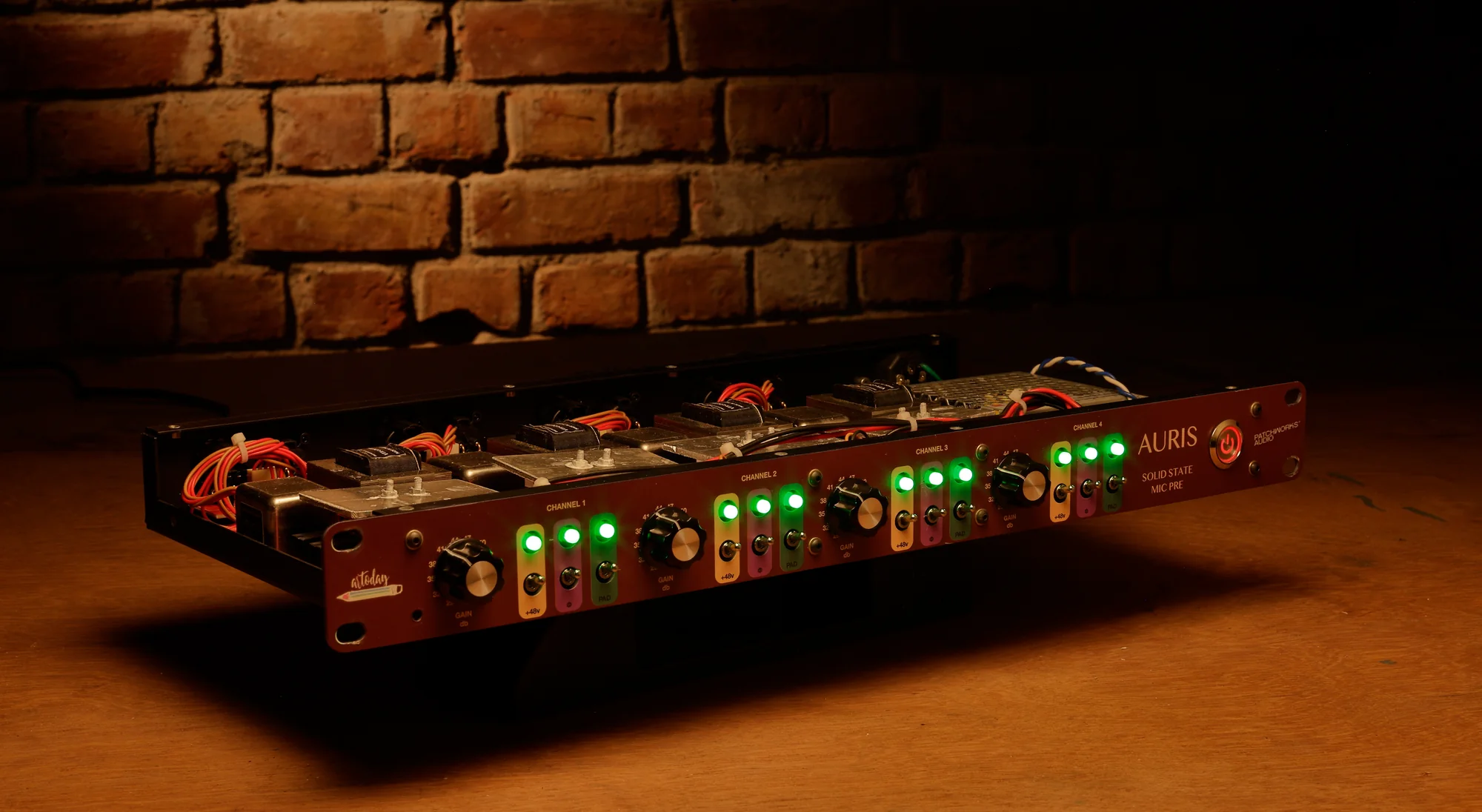
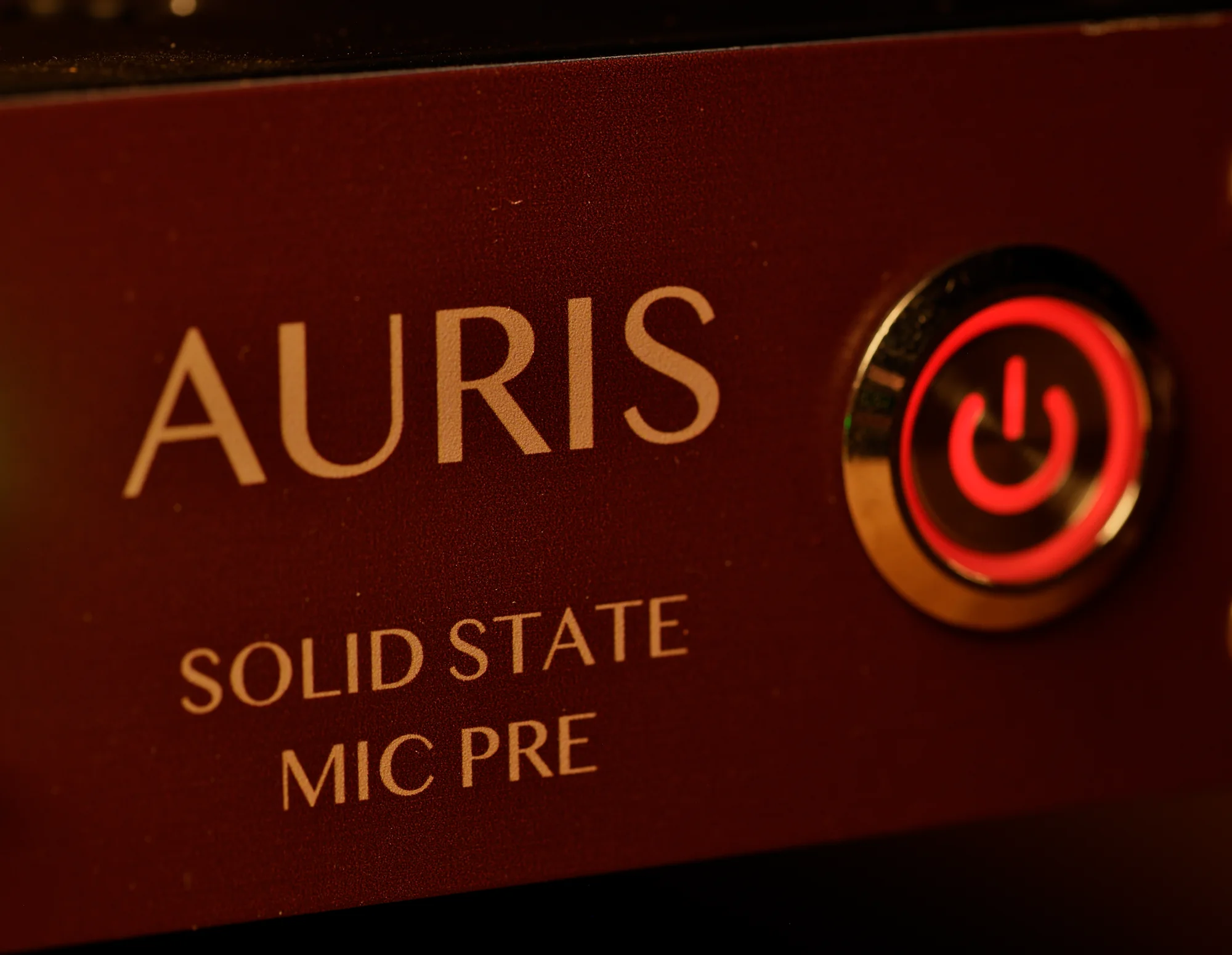
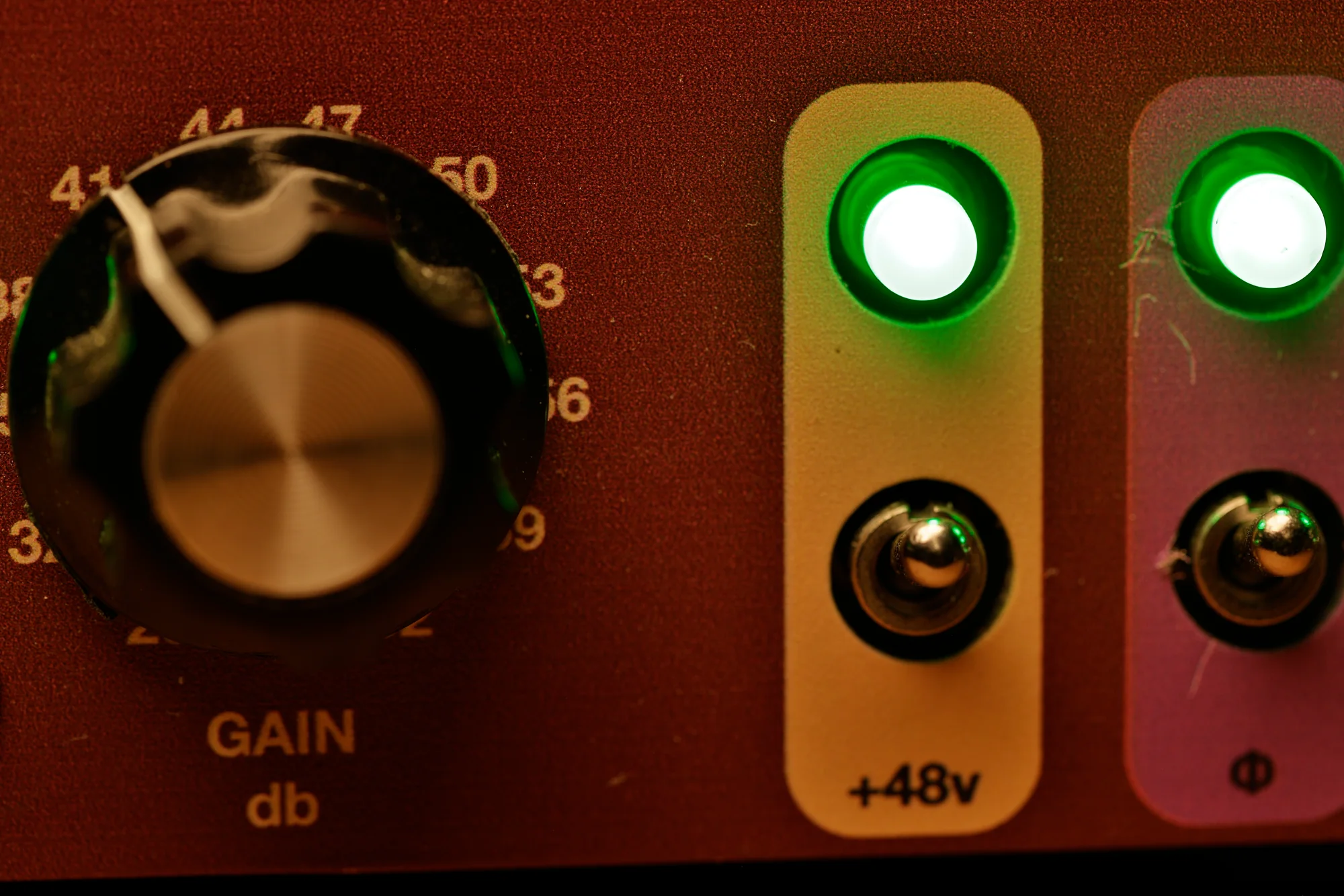
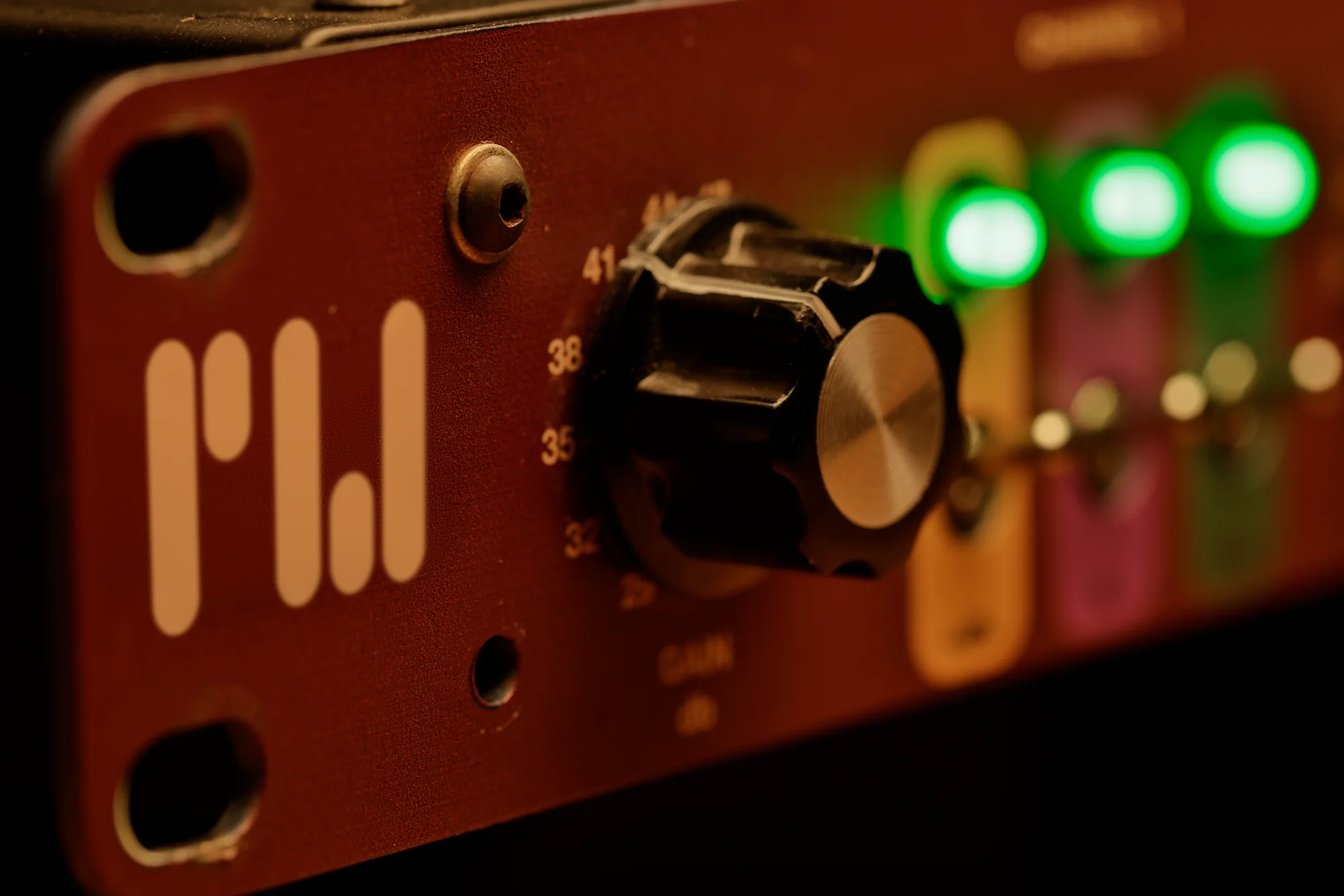
Up close
Photographed on the bench.
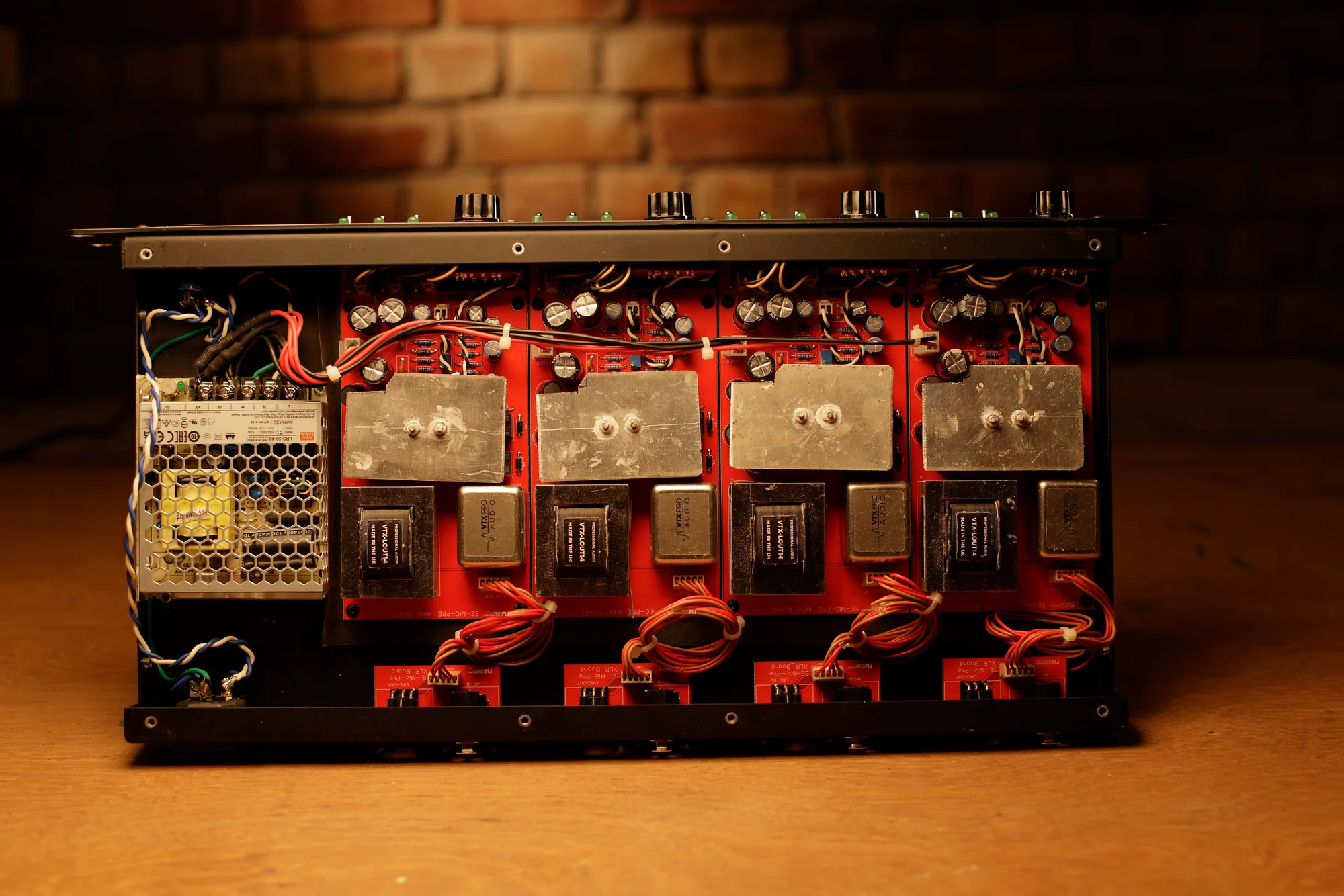
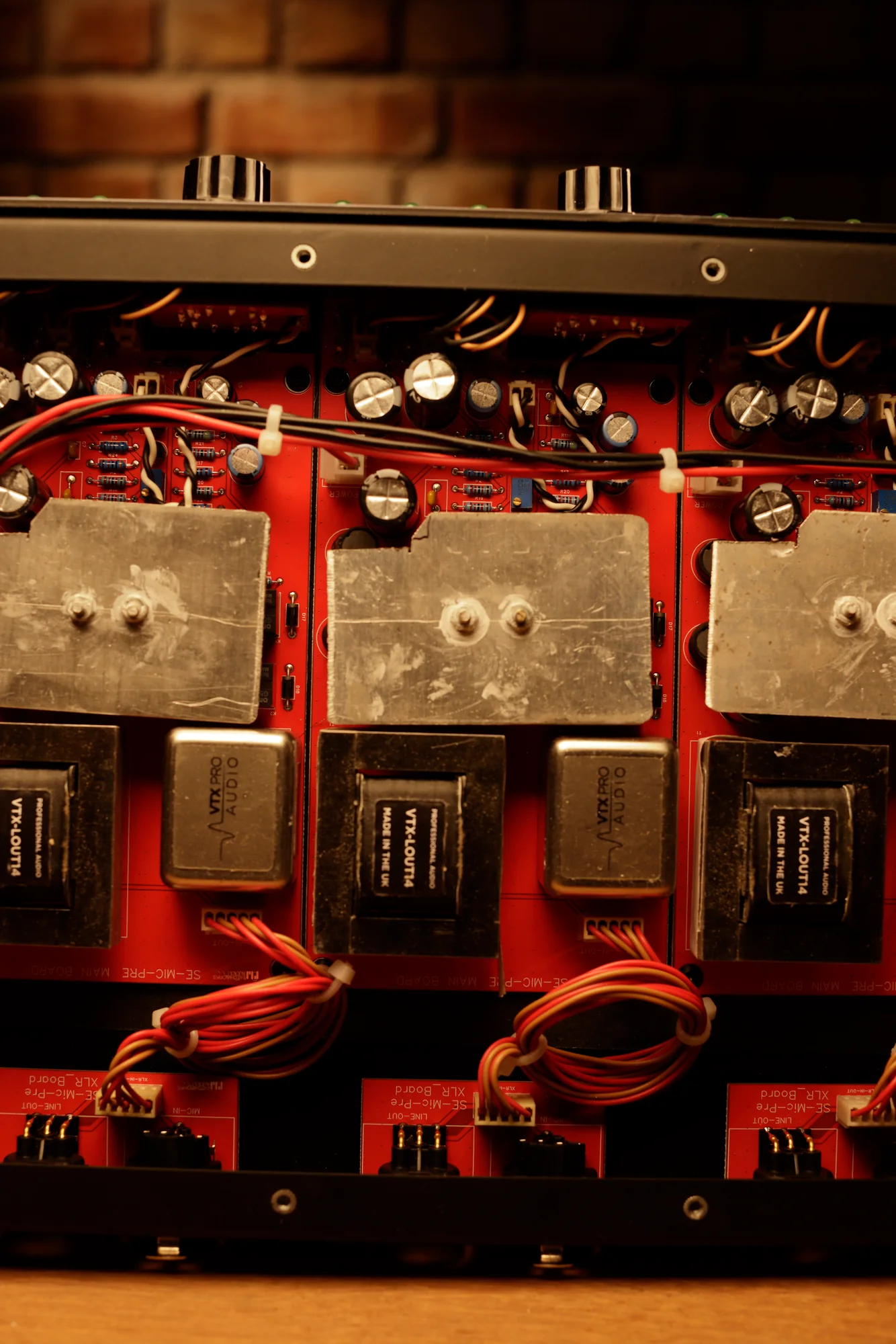
How it works
Inside the Auris.
Every stage is discrete and through-hole, each chosen and biased for one job. The signal runs left to right; the loop beneath it is the feedback that the 12-position gain switch sets.
Input transformer
Gain before any transistor. It steps the mic signal up with galvanic isolation and high common-mode rejection, and a damping network on the secondary tames the transformer’s resonance.
Relays, not panel switches. Gold-contact relays switch the −20 dB pad and polarity, so the signal never passes through a front-panel switch. Phantom power comes from its own filtered supply.
An illustration of the signal path, not a schematic or a measurement.
Controls
Named as printed on the front panel.
+48v
Phantom power for condenser microphones, from its own filtered supply. The LED above it lights when it’s on.
Choose a control to see what it does. Every channel has the same controls; Power is on one side only.
Hear it
Dry against Auris, level-matched.
Coming soonTabla, acoustic guitar and cajón, played soft then hard, recorded dry and through Auris.
Your unit
From your enquiry to your bench.
Auris
Four-channel solid state mic pre
1U19″ rackBuilt to order
Price on request
Send enquiry
Add Auris to your cart and tell us about your studio and what it’s for. You sign in to send it.
We reply within a week
To your account’s email, and what you asked about stays in your account.
Built to order
Every unit is built for the person who orders it.
Questions first? Write to audiopatchworks@gmail.com
Specifications
Design figures until each unit is measured.
At a glance
- Four channels in 1U
- Discrete, single-ended Class A
- Transformer in, transformer out
- Stepped gain: 12 positions, about 3 dB apart
- +48 V, pad and polarity on every channel, each with its own LED
- Pad and polarity on gold-contact relays, not panel switches
- Type
- Microphone preamplifier, four channels
- Topology
- Discrete, single-ended Class A; transformer-coupled input and output
- Gain
- 12 steps of about 3 dB, marked 29 to 62 dB
- Gain switch
- 12-position rotary, 0.1 % thin-film resistors
- Pad
- −20 dB, relay-switched
- Polarity
- Relay-switched
- Input impedance
- About 1.9 kΩ
- Output stage
- Darlington follower with a 50 mA constant-current sink
- Output
- Transformer-balanced, floating, outside the feedback loop
- Microphone inputs
- XLR-F, Neutrik, one per channel
- Line outputs
- XLR-M, Neutrik, one per channel
- Phantom power
- +48 V, filtered, switched on each channel
- Power
- 48 V DC
- Rack space
- 1U, 19″ rack
- Front panel
- 43.7 × 482.6 mm
- EIN
- Not yet measured
- Maximum output level
- Not yet measured
- Frequency response
- Not yet measured
- THD+N
- Not yet measured
- Crosstalk between channels
- Not yet measured
Each figure will be measured on the bench and published here with the test conditions behind it.
In a chain
One way to run it, in signal order.







