
Mach Box
Iron first. Then the edge.
Eight-channel passive saturator
Price on request. Built to order
The sound
Copper, iron and junctions.
There is no drive control for the transformer: input level, and how much low end it carries, decides how hard the iron works. Each octave down takes 6 dB less signal to reach the knee, so kick and bass saturate first.
Fully passive
No supply and no active stage: the signal meets a transformer, a clipper and nothing else.
Transformer-isolated
A floating secondary drives the output.
Two clip engines
Silicon diodes, tight and bright with a firm knee; or red LEDs, with a higher threshold and a rounder knee.
Symmetric or asymmetric
Clip both halves of the wave, for odd harmonics, or one, and even harmonics join in.
The source is part of the circuit
The input drives the transformer directly, so its colour scales with the impedance driving it. A transformer-coupled or higher-impedance source draws more iron colour than a stiff op-amp output: same box, same level, different colour.
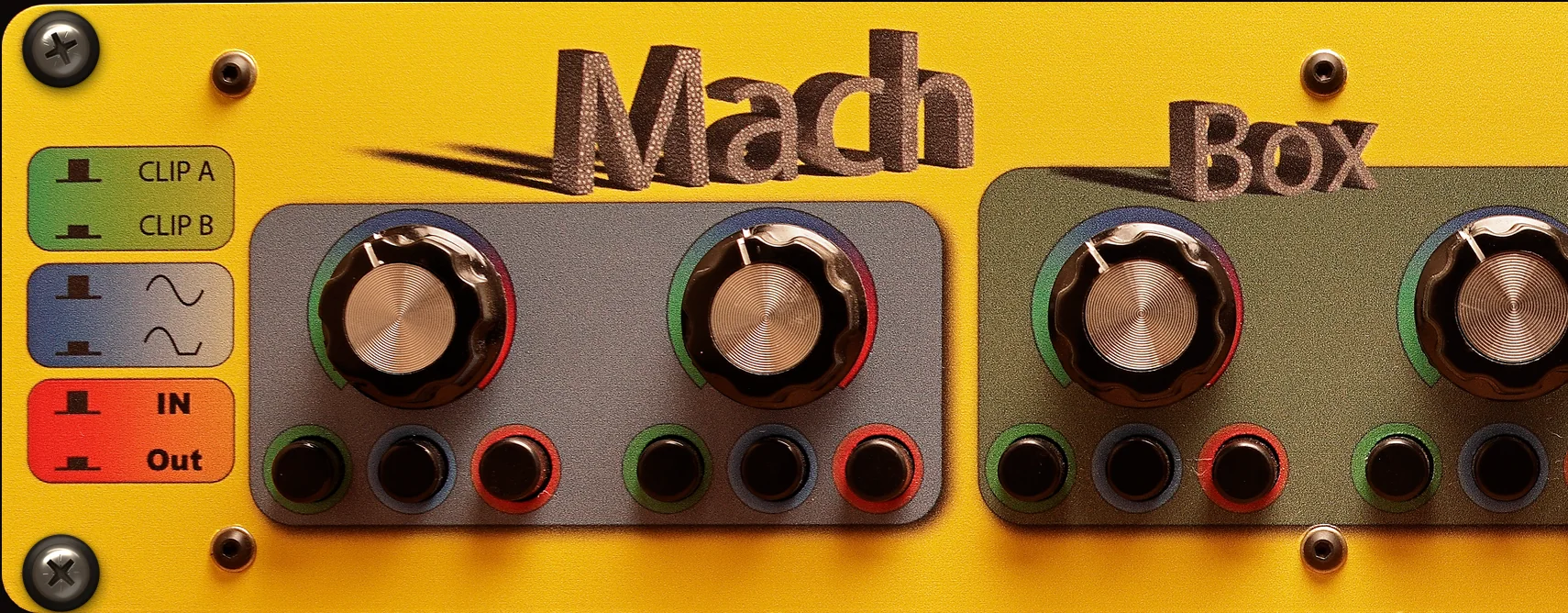
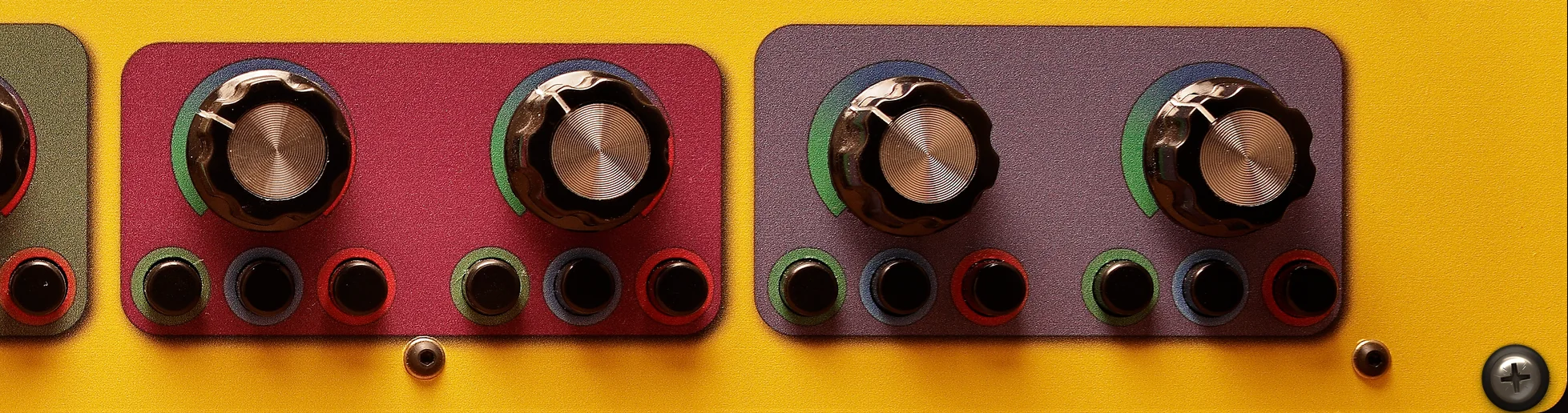
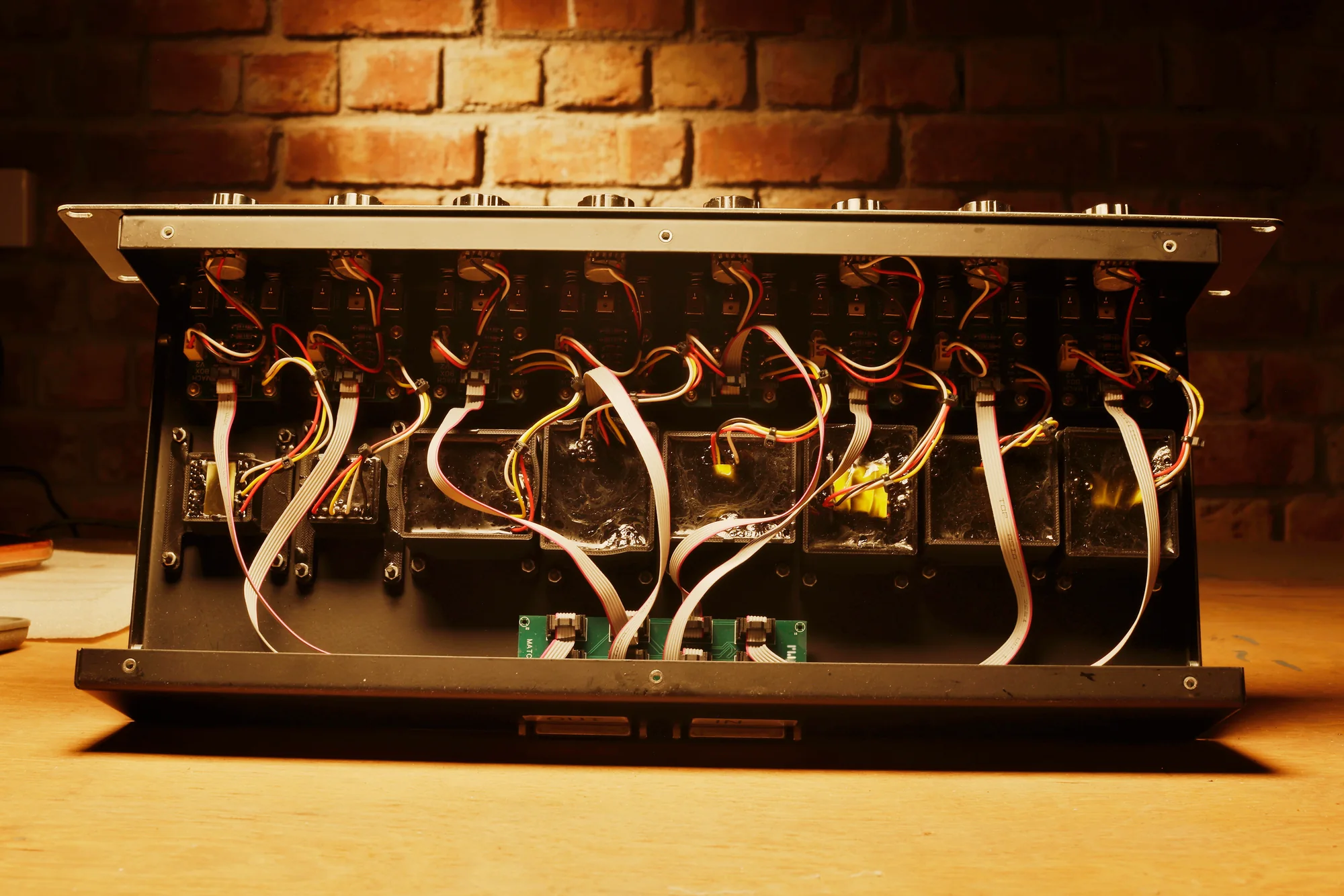
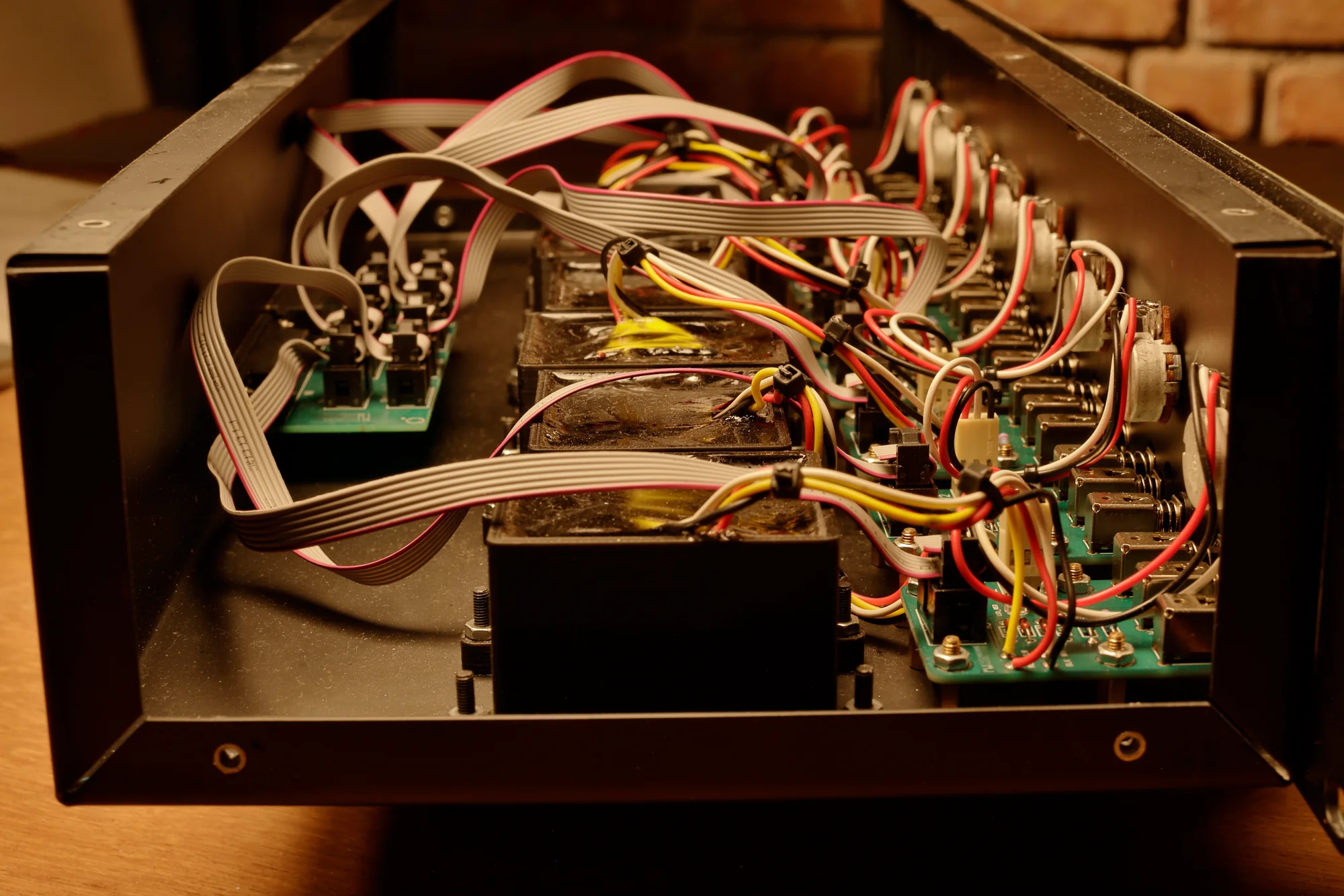
Up close
Photographed on the bench.
How it works
Two stages. No power.
The signal runs through two non-linear stages and nothing else: first a transformer, where low frequencies push the iron towards saturation, then a shunt clipper, silicon or LED, dialled in with a single control.
The iron
Flux is set by volts per hertz, so the same level works the iron harder the lower the note. Near the knee it bends the waveform: mostly odd harmonics, led by the third. Below the knee it adds a smaller, level-dependent colour of its own.
Hard-wired bypass. Bypassed, the input connects straight to the output. The processed path runs quieter than bypass, so match levels before comparing the two.
Bring make-up gain. It’s passive: hard clipping holds the output around 1 to 2 V peak, so follow it with a line amp or preamp.
An illustration of the signal path, not a schematic or a measurement.
Controls
Named as printed on the front panel.
Clip
Sets the share of the output the clipper sees: from off, where it sees nothing, to full rotation, where it sits straight across the output. Threshold and knee move together.
Choose a control to see what it does. Every channel has the same controls.
Hear it
Dry against Mach Box, level-matched.
Coming soonSound samples are being recorded.
Your unit
From your enquiry to your bench.
Mach Box
Eight-channel passive saturator
2U19″ rackBuilt to order
Price on request
Send enquiry
Add Mach Box to your cart and tell us about your studio and what it’s for. You sign in to send it.
We reply within a week
To your account’s email, and what you asked about stays in your account.
Built to order
Every unit is built for the person who orders it.
Questions first? Write to audiopatchworks@gmail.com
Specifications
Design figures until each unit is measured.
At a glance
- Eight channels in 2U
- Fully passive: no power supply
- Transformer saturation, then a shunt clipper
- Two clip engines: silicon diodes or red LEDs
- Symmetric or asymmetric clipping
- Transformer-isolated output, hard-wired bypass
- Type
- Passive saturator: transformer saturation followed by a shunt clipper
- Silicon engine
- Two series junctions per polarity, about 1.1 to 1.5 V peak
- LED engine
- Two red LEDs, antiparallel, about 1.7 to 2.2 V peak
- Controls
- Clip (continuous), clip engine, clip type, bypass
- Bypass
- Hard-wired, input to output
- Input
- Balanced, into the transformer
- Output
- Balanced, floating transformer secondary (effect engaged)
- Output build-out
- 2 × 220 Ω, one per leg
- Power
- None required
- Rack space
- 2U, 19″ rack
- Front panel
- 88.1 × 482.6 mm
- Frequency response
- Not yet measured
- Saturation onset at 40 Hz
- Not yet measured
- THD at +4 dBu, 1 kHz
- Not yet measured
Each figure will be measured on the bench and published here with the test conditions behind it.
In a chain
One way to run it, in signal order.





